

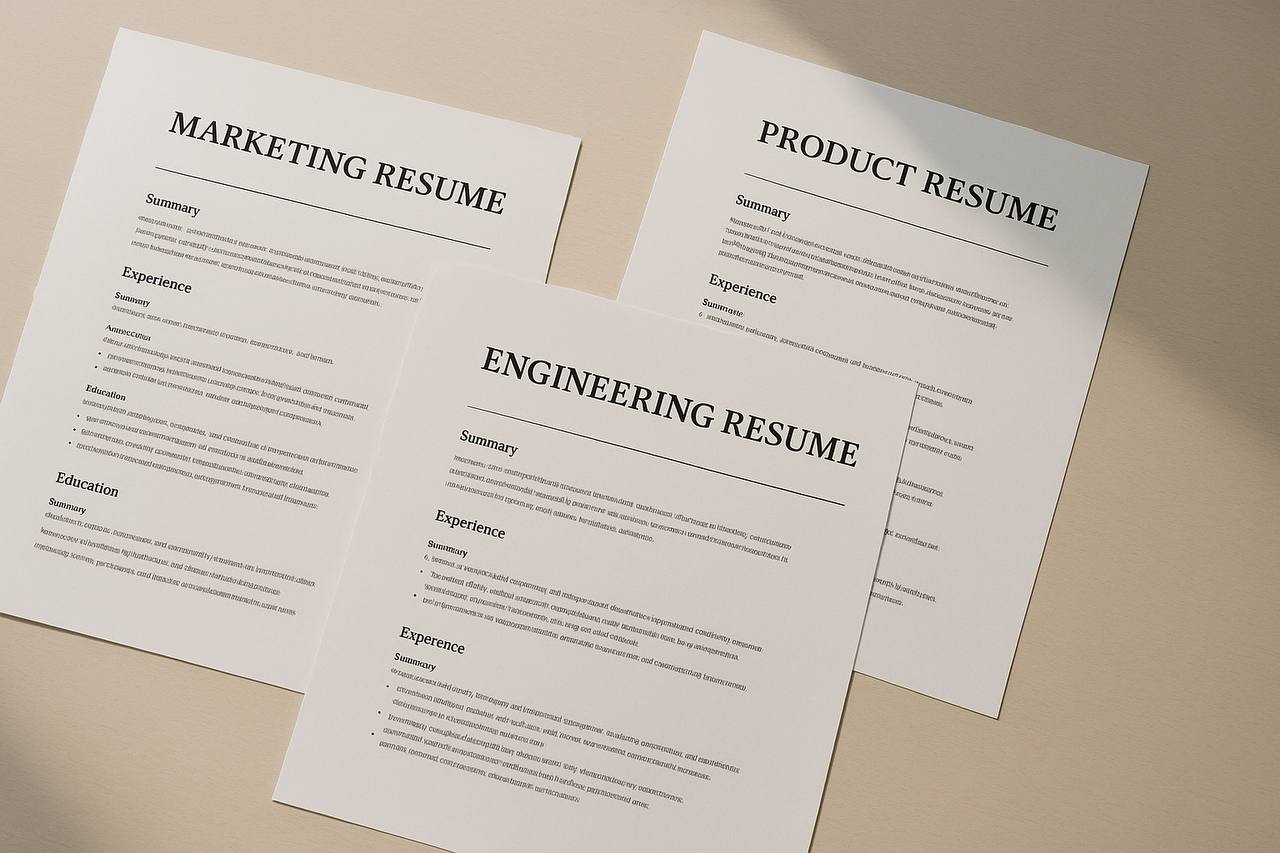
Why One Master Resume Is No Longer Enough in 2026
The era of the one-size-fits-all resume is officially over.
By 2026, the hiring landscape has evolved faster than most job seekers realize. Recruiters rely heavily on Applicant Tracking Systems (ATS), semantic matching, and competency-based models. Roles have become more specialized. Competition has gone global.
In this environment, one “master resume” — no matter how polished — is no longer enough to stay competitive.
If you’re still using the same resume for every application, you’re quietly losing opportunities long before a human ever sees your name.
This guide explains exactly why a single master resume fails in 2026, how ATS and recruiters evaluate your profile, and what you can do to adapt — including how AI tools can automate resume tailoring at scale.
The Job Market in 2026 Demands Hyper-Relevance
Five years ago, having one strong resume was considered good practice. Recruiters skimmed more manually, and algorithms were simpler. A generalist profile could still make it through.
In 2026, things are different.
1. ATS systems now prioritize semantic relevance
Modern ATS platforms don’t just search for keywords; they analyze:
• how closely your skills and experience match the job description,
• how your responsibilities align with required competencies,
• whether your profile fits the level and context of the role.
If your resume feels generic or misaligned, your match score drops — often before a recruiter ever opens your application.
2. Recruiters are flooded with candidates
Remote and hybrid work massively expanded the talent pool.
For many roles, recruiters receive hundreds of applications. To cope, they prioritize resumes that:
• clearly speak to the specific role,
• use the company’s language,
• highlight relevant achievements quickly.
Generic resumes are the first to be ignored.
3. Competition is global, not local
You’re not just competing with people in your city anymore. You’re competing with candidates from:
• North America
• Europe
• LATAM
• Asia-Pacific
Many of them already tailor their resumes for each role. If you don’t, you’re behind by default.
4. Roles are more specialized than ever
A “Product Manager” is no longer just a “Product Manager.” In practice, you see:
• Product Manager (FinTech)
• Product Manager (AI/ML)
• Product Manager (B2B SaaS)
• Product Manager (E-commerce)
• Growth Product Manager
A single master resume cannot speak with equal relevance to all of these roles at once.
What a Master Resume Is — and Why It Used to Work
A master resume is a comprehensive document that includes:
• your full work history,
• every skill you might want to mention,
• a wide set of projects and achievements.
It’s supposed to be a “source of truth” — a base version that you customize for each application.
The problem?
Most people do not actually customize it.
They start applying with the same master resume everywhere because tailoring takes too much time and mental energy.
In a slower, less automated hiring market, you could still get away with this.
In 2026, you can’t.
The Core Problem With One Resume: Relevance Decay
Even a well-written master resume becomes less relevant the moment you use it for multiple roles.
Each job description has its own:
• required skills,
• preferred tools and technologies,
• seniority expectations,
• domain context (FinTech, healthcare, e-commerce, etc.),
• key performance indicators (KPIs) and success metrics.
Modern ATS and recruiters are looking for tight alignment between your resume and that specific role.
If your resume tries to be everything at once, it ends up being:
• not focused enough,
• not specific enough,
• not compelling enough for any one role.
This is what we call relevance decay — the more roles your resume tries to cover, the less relevant it becomes for each of them.
How ATS Penalizes Generic Resumes
Modern ATS systems (Greenhouse, Workday, Lever, SmartRecruiters and others) use increasingly sophisticated scoring models.
They evaluate:
• Keyword relevance – Do you use the same language as the job description?
• Skills alignment – Do you list the tools, frameworks, and competencies the role demands?
• Level alignment – Does your experience match the seniority level?
• Context match – Have you worked in similar industries or environments?
A generic resume that doesn’t emphasize the right skills and contexts will:
• get a lower match score,
• be ranked below more tailored profiles,
• sometimes be filtered out automatically.
You won’t get a notification. You’ll just never hear back.
Real Reasons Job Seekers Fail When Using One Resume Everywhere
Let’s break down typical failure patterns when someone relies on a single resume:
1. Different industries expect different narratives
Marketing in e-commerce is not the same as marketing in healthcare.
A master resume that doesn’t highlight domain-specific experience will feel too generic.
2. Different levels require different emphasis
A junior role emphasizes execution and learning.
A senior role emphasizes leadership, strategy, and impact.
One universal resume often sends mixed signals: too senior for some roles, not senior enough for others.
3. Different roles use different language
AI companies, logistics companies, and consumer apps may describe similar responsibilities using very different terms.
If you don’t mirror the wording of the job description, the ATS may not recognize your experience as relevant.
4. Different roles care about different metrics
SaaS businesses care about retention, activation, MRR.
Operations roles care about SLA, efficiency, error rate, throughput.
If you use generic “improved results” statements, instead of domain-specific metrics, your impact lands weakly.
5. Recruiters skim for specific signals
A recruiter given 200 resumes quickly scans for:
• must-have skills,
• relevant industry,
• matching role titles,
• evidence of impact.
A generic master resume rarely surfaces those signals in the first few seconds.
Why Tailored Resumes Consistently Outperform Generic Ones
Several independent studies and internal hiring analyses between 2023 and 2025 show that:
• Tailored resumes get 2–3× more interview invites compared to generic ones.
• ATS match scores can increase by 40–70% when resumes are aligned with the job description.
• Recruiters spend significantly more time on resumes that feel purpose-built for their role.
In short:
Relevance is now one of your biggest competitive advantages.
The problem isn’t that your skills are weak.
It’s that your resume isn’t telling the right story for each opportunity.
What Parts of Your Resume Should Change for Each Job
You don’t need to rewrite your entire history for every application.
But some key sections should adapt.
1. Skills section
Your skills section should:
• emphasize skills that are explicitly mentioned in the job description,
• de-prioritize or remove skills that are irrelevant to this role,
• use consistent terminology with the posting (e.g., “lifecycle marketing,” not just “marketing”).
2. Experience bullets
Each role should highlight achievements that match:
• the seniority level,
• the type of company (startup vs enterprise),
• the domain (FinTech, SaaS, AI, logistics),
• the responsibilities described in the posting.
You might reorder bullets or swap some examples entirely.
3. Keywords from the job description
Modern ATS systems look for direct and related keyword matches.
If a job mentions:
• “experimentation,”
• “A/B testing,”
• “hypothesis-driven decisions,”
and your resume only says “improved performance,” you’re leaving relevance on the table.
4. Tools & technologies
A hiring manager scanning for “Figma, Jira, HubSpot, SQL” doesn’t want to see only “design tools,” “task trackers,” or “marketing platforms.”
Specific tools often act as filters.
5. Achievements and metrics
You don’t need to invent new achievements.
You just need to foreground the ones that matter most to each role.
Why Manual Tailoring Is Unrealistic at Scale
In theory, everyone agrees:
“You should tailor your resume for every application.”
In practice, job seekers face:
• 30, 50, sometimes 100+ applications over a search cycle,
• limited time and energy,
• frustration and burnout from repetition.
Manually tailoring each resume can take:
• 20–40 minutes per application (if done properly),
• several hours per day,
• dozens of hours per month.
It’s no surprise that most people eventually give up and go back to using one master resume.
That’s where AI-assisted tailoring becomes not just helpful, but almost necessary.
How AI Finally Solves the Resume Tailoring Problem
AI tools are uniquely suited to handle the repetitive, pattern-based parts of resume customization.
Here’s what modern AI can do for you:
1. Automatically extract keywords from the job description
AI can scan a posting and instantly identify:
• primary responsibilities,
• must-have and nice-to-have skills,
• tools and technologies,
• seniority signals.
2. Rewrite bullets for relevance
AI can rewrite your existing experience bullets so they:
• emphasize the right competencies,
• mirror the language of the job description,
• highlight the most relevant achievements.
3. Generate multiple tailored versions in seconds
Instead of manually building 10 different resume versions, AI can generate:
• a FinTech-focused version,
• a SaaS-growth-focused version,
• a data/analytics-heavy version,
all from the same base experience.
4. Optimize for ATS formatting
AI-powered tools can maintain:
• a clean, ATS-friendly structure,
• consistent headings,
• clear bullet formatting.
5. Score how well your resume fits the role
Some tools (like CareerMagic) can provide a match score or qualitative feedback that tells you:
• where your resume is strong,
• what’s missing,
• what can be improved before you hit “apply.”
How CareerMagic Helps You Move Beyond the One-Resume Trap
CareerMagic is designed specifically for job seekers who:
• are applying to many roles,
• don’t have hours per day to rewrite resumes,
• want higher-quality applications without burning out.
With CareerMagic, you can:
• upload a master resume once,
• let AI parse and structure your experience,
• paste or import any job description,
• generate a tailored, ATS-optimized resume version in seconds,
• keep track of which version you used for which application.
Instead of choosing between “quality” and “quantity,”
you finally get both:
• tailored resumes at scale,
• relevance without endless manual editing,
• a more strategic job search process.
Final Checklist: Is Your Master Resume Quietly Holding You Back?
If any of the following statements is true, your current approach is likely costing you opportunities:
• You send the same resume to more than three different roles.
• You rarely update your resume wording based on each job description.
• You apply to roles in different industries using the same version.
• You don’t explicitly mirror the terminology used in postings.
• You can’t remember the last time you removed irrelevant skills or projects.
• You rarely get interviews for roles you feel very qualified for.
If this sounds familiar, it’s not that you’re not good enough.
It’s that your resume strategy is stuck in a pre-ATS world.
Conclusion
A master resume still has value — as your source document, your personal experience database.
But in 2026, it can’t be the final product you send to every employer.
The job market now rewards:
• specificity,
• relevance,
• alignment with each role.
Tailored resumes outperform generic ones, both with ATS and with human recruiters.
The good news?
With AI tools like CareerMagic, tailoring no longer has to be slow, painful, or overwhelming. You can bring your experience into the 2026 hiring reality — and finally give yourself the advantage you actually deserve.

Leave a Reply